Intermedia - Halfway Through
- Demetra Chiafos
- Oct 5, 2018
- 4 min read
When I first signed up for Intermedia, I had no idea what to expect. I had heard from upperclassmen throughout my freshman and sophomore year that this was a wonderful class to take for anyone focusing in Composition (in other words—me.) Though I knew that this was an involved class when it came to making things and technology, I didn’t know what I would be doing.
This course immediately opened my sensitivity to what a huge range of possibilities there are for combining movement, technology, props, costumes, etc. to create a cohesive work. We have made one study thus far, though we have many more coming.
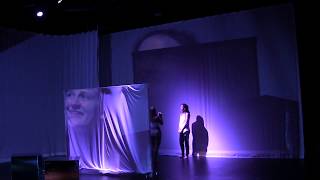
Our first assigned study was to create a “portrait” of someone by utilizing “digital doubles” of ourselves (meaning, somehow “doubling” ourselves mainly by using cameras and projectors.) Here are some pictures from us messing around:


Kyla and I had so much fun bringing props into the space to just see what we could make, and playing with the lighting board to see how the space we created shifted depending on what lighting we used. Once we achieved our “doubling” we found ourselves asking two questions: what movement should we generate to go with our doubles, and did we want to use music?
The video of the study is below, along with a summary of our process and what I learned from creating it and hearing our peers’ feedback.
The title of our work is Outside In. (From the audience we could not be seen whilst interviewing each other except through the projector screen - it was nearly impossible to get that angle while we were showing though, due to the logistics of where everything was in the room!)
Instead of using music, we settled on creating a text, which raised the question of what our text should be about. Trying to generate a script, we started speaking randomly about whatever came to mind—which ended up being describing each other. We decided to describe each other more generally—like, “she has brown hair” instead of “Demetra has brown hair”—to retain some ambiguity for the audience. When we came out from behind the initial projector screen and did our solos, we improvised based on the movement qualities we described seeing in the other person, trying to embody each other as dancers.
After that, we came forward from behind the projection screen. We thought that speaking about each other and having solos created some narrative distance between us. Therefore, we decided to have a contact improvisation section to “close the distance” between us and wrap up our dramatic arc—going from strangers with vague impressions of each other to friends. We decided to end with reflecting on and replying to the things the other person had said about us at the very beginning—thus the title, “Outside In,” moving from external perceptions of each other to our own internal ideas about ourselves.
When our peers reviewed our piece, it was interesting to see what read to the audience and what didn’t. We discovered that certain markers in our language created a certain context for the audience. They immediately placed our characters as “young” due to us talking about “classes,” the other person’s “friend group,” and our parents. They also wondered why we were trying to describe someone we barely knew, and came to two likely conclusions as to why you would describe someone you barely know: one being that something had happened and it was a newscast, and the other being that perhaps you have a crush on the person you’re describing.
While playing around with our material after showing it, we discovered that to achieve our goal of “closing the distance” and “befriending each other” a better ending would have been for us to do a follow-the-leader improv (making the leader clear by having them stand on one of the mirror boxes while the other is at ground level) and verbally describing each other’s movement qualities to each other. It was extremely informative as to how things read to the audience and what cultural contexts we associate with certain styles of movement or certain topics of conversation.
As far as what we've done in class other than our first study, I have been very intrigued by the discussions in our course about what is “real” or “not real”—as well as other, perhaps better dichotomies we have defined, such as “genuine” and “artificial” or “digital” and “actual.” We’ve discussed that it is very dangerous to write off something as “not real” simply because it exists in “digital space.” For example, cyber-bullying happens in digital space, but its effects are certainly very real.
Something in one of our readings about digital performance, Digital Doubles by Steve Dixon (2004), also intrigued me: that the computer monitor has become a proscenium arch. One could consider YouTubers as performers on a cyber stage, as well as anyone who has a Facebook, Instagram, Tumblr, Twitter, etc. Technically, we are all “performing” every day of our lives.
Yet another discussion we have had in Intermedia this semester is about power dynamics. One way we have addressed this is during our portrait studies, and the portrait exercises we did as practice in class beforehand. We all felt very uncomfortable dictating to someone else what the important parts of their personality are, let alone how those parts should be portrayed through movement/technology. I have been considering what it means to be a choreographer, director, teacher, dancer, student, etc. and to be all those things respectfully and fully while leaving space for other people.
Besides philosophical questions and compositional tools, I have gained more hands-on technological knowledge. I can now operate projectors, as well as the Isadora program, and troubleshoot basic technological difficulties! And I know my way around the motion lab, which is exciting as it will open up future possibilities for me. I have enjoyed looking for cool textures in my environment for our second study about textures, and, most notably, have found gorgeous things in my environment that I walk past every day without giving a second glance. It's made me want to stop and smell the roses more.
Overall, this course has already shaped me as a maker, a dancer, an audience member, a thinker, and a person. I am looking forward to what else I learn throughout the second half of the semester.




Comments