Intermedia Final Reflection
- Demetra Chiafos
- Dec 6, 2018
- 6 min read
I would say the biggest thing I’ve learned in Intermedia this semester is how to pull apart a work, find what makes it tick, and really bring that out. This started with the first study Kyla and I created together in our lab. Our task was to make a portrait of one or both of us, using digital doubles. You can view our study here:
What we found very interesting about this study, which I wrote about at length in my midterm reflection, was that the words the interviewee chose had a profound impact on the audience’s perception of the performer and the work. For example, we seemed much younger than we are because we referenced “classes,” “friend groups,” and our moms. The way we spoke about each other also indicated to the audience that either something horrible had happened or that we had a crush on the person we were talking about—because why else would you talk a lot about “someone you barely know?” That was not something that we had taken into consideration.
For our second study about textures, we started by just making something and not trying to shape a specific narrative. You can view our second study here:
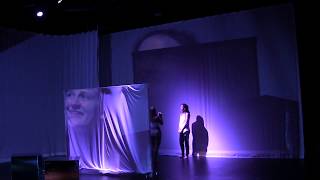
We had already taken videos of textures for a prior assignment, so we chose the videos that interested us the most and built the projections that would go onto the screens. Then we found ways to align ourselves with those textures—like me sitting on the block and blowing up the balloon instead of blowing bubbles of gum. Kyla decided to mirror the sound of the balloon inflating and deflating with her movement. We wanted the video audio, which is rather jarring and aggressive, to have a cue to come on, so we decided that Kyla would pop my balloon and I would run off. Then we wanted to transition into an “outer space” vibe by layering two of my textures together (which were blue light moving and bubbles in the kitchen sink.) Kyla’s movement quality became melting and weighted to evoke the idea of zero gravity. Kyla thought it would be cool to bring the balloons back at the end. When she went shopping for them she found some balloons that lit up, so we considered those “stars” or “planets” in our universe that we had created. The solution to get the balloons out into the space was, again, technical—I just threw them.
Our classmates and Norah mostly talked about the power dynamic inside our work—that Kyla popping my balloon was rather violent, that I didn’t react much, and that there was never a moment where I got to have “my say” after I ran off the stage. However, they also read an older/younger sibling relationship into it—like Kyla was the bigger sister bossing me around while playing in the living room, saying “and now you move this prop!” and so forth. To bring out the sibling relationship in it and to make my lack of response to Kyla popping my balloon seem less serious (since creating a power dynamic wasn’t really our goal with this work), one solution we came up with was for me to walk all the way into the space and directly throw the balloons at Kyla toward the end of the piece.
For our third study, our task was to create an audience participative work. Kyla and I had both never created a work that drew on audience participation, but while brainstorming with our lab GTA, Claire Melbourne, we came up with the idea of having a “birthday party” for Oded Huberman so that we could highlight him and honor him. He does A LOT of work for our course to support us and help us make the studies that we want to make, and he tends to stay hidden in the shadows of the tech booth.
So, when creating this, we thought about typical birthday party activities and games. Kyla had the idea to make a technological Twister game, which I executed with a lot of help from Claire—we went through and manually created every circle for the game and set it to project from the ceiling projector onto the ground. Claire helped me to set motion-capture parameters in the space that would detect if someone was standing in a certain place and spinning: the spinning would then trigger the prompts (“right foot green” and so forth) to cycle through on the large screen.
We told Oded at the beginning of the study (he didn’t know what we were doing) that we were playing children’s games and asked him to step out into the hallway because he was “it” for hide-and-seek. We then gave everyone else party hats, told them it was Oded’s birthday, and instructed them to hide so they could jump out and surprise him. After that, we moved through the Twister game and the rest of the study.
We also brought a cake and a present for Oded, and we brought party favors to end the study with. The most interesting part of this study actually came from a mistake. We didn’t bring silverware for the cake! We decided it was fine because not having silverware to eat the cake with made the study more of an artistic work and less of a literal birthday party. Our participants said that it was the most interesting part of the study for them, because it gave them a problem to solve (Norah eventually took the cake from Oded and took a huge bite out of it, before they used their hands to break it into pieces.) Kyla and I decided that if we were to re-do or further develop our study, we would want to pursue ways that we could make it less of a straightforward birthday party.
This final participative study was the largest challenge for Kyla and I, because, as I said, neither of us had much prior experience with participative works. I have a lot of thoughts now about audience participation that I never really considered before this course. While we discussed audience interaction in class to prepare us for creating these studies, the subject of audience consent came up, which is rather tricky. One of my classmates was once put in a position where a performer asked her to help him remove his pants (he had something on underneath them.) In that situation, she felt extremely uncomfortable but went along with it because if you’re the person who says “no” when invited to participate, everyone else thinks you’re a “party pooper.”
In a similar vein to audience participation and interaction, another large take-away I received from this course was a connection with the lineage and history of intermedia art. The Dadaists are one of my favorite examples—particularly when Max Ernst placed a hammer next to his artwork, hoping that audience members would take it and smash work that they didn’t like. Except, as audience members, we’re conditioned to observe and not to interact. The audience evaluated the hammer Ernst left out curiously, as if it were part of the art. These conversations about audience consent, Dadaism, etc. have left me very interested in our culture surrounding performances, performers, and audiences.
Another thing I gained from this course, which I’m planning on implementing in my personal practice, was our “notice what you notice” walks. We would go on walks outside, during which we would not speak, merely observe our environment—its colors, textures, sounds, patterns, mechanisms, and systems. While we were talking about Dadaism and audience participation we had some interesting discussions about our most recent “notice what you notice” walk. Emily and I were partners on this walk and we were approached by a man who asked us if we wanted a flyer about the upcoming election—but on these walks, we don’t speak!
I had a huge internal grapple with if not verbally replying was rude—and if it was, was it worse to do something culturally rude, or worse to break the rules of this game? Emily just smiled and shook her head no, and he left. Meanwhile, Tara got strange looks from passersby for simply standing still and looking at a tree. Tara raised the point that if she was standing there holding a smartphone, no one would have noticed anything out of the ordinary. Norah also pointed out that as a group of Caucasian women, we are perceived as non-threatening, and people may have reacted differently if we were not.
This raised all sorts of questions and thoughts about how we could use dance to provoke thought or as a means of peaceful protest—even if what we’re protesting is as small as walking on campus every day with your nose in your smartphone, never stopping to appreciate the trees.
Now I’m left wondering about how the audience reads works and why; what kinds of interaction are pleasant for audience members and why; and how to navigate all of these things. In the end, this course made me feel very empowered as a maker and even more curious about making.
I also learned a lot on the tech side of things! Isadora is really cool, and I feel way more confident when operating sound boards, Isadora, projectors, and cameras now.




Comments